
Ask people which Japanese test to take and you will often get different answers. One says the JLPT is the only certificate that counts. Another says everyone going to Japan for work takes the JFT-Basic now. A third mentions the NAT-Test because it runs more often. They are all partly right. That is the problem.
The honest answer depends on what you need the certificate for. These three tests overlap at the beginner levels, but each was built for a different job. In 2026 the rules around them shifted: the JFT-Basic changed how it reports scores in August, and Japan’s new Employment for Skill Development programme begins in April 2027. This guide sets out what each test is, who accepts it, and which one fits your goal.
Not sure what level you are at yet? Take our free JLPT level test first. It takes about twenty minutes, and every answer below depends on your current level.
The short answer
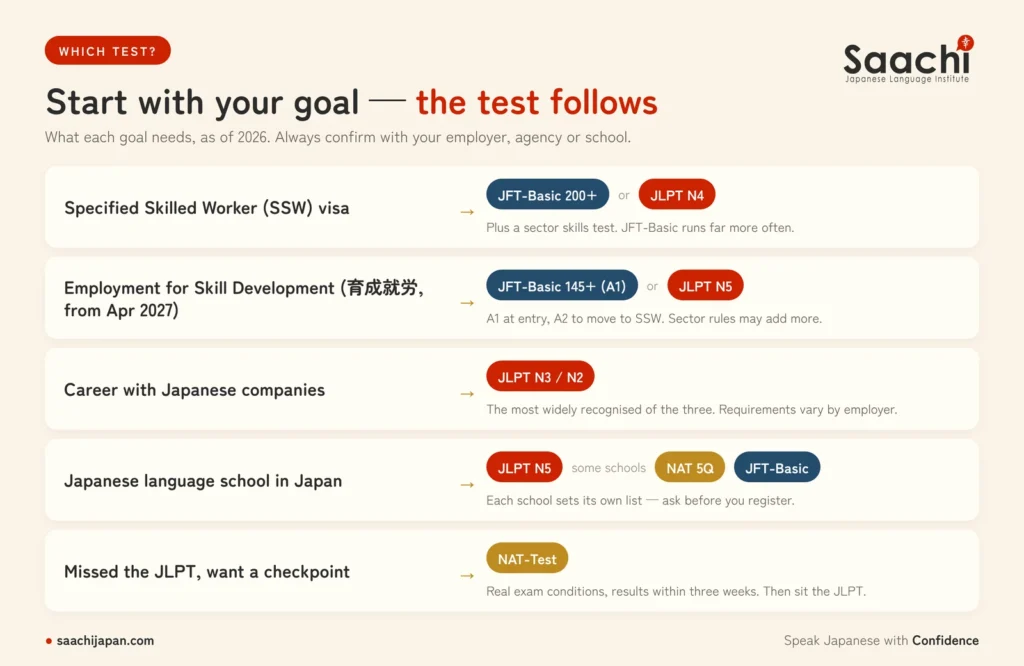
- Going to Japan on a Specified Skilled Worker (SSW) visa? Take the JFT-Basic (score 200+) or JLPT N4. Most candidates take the JFT-Basic because it runs far more often.
- Joining the Employment for Skill Development programme (from April 2027)? The JFT-Basic now reports the A1 level that programme needs at entry. JLPT N5 is the other common proof.
- Want a career with Japanese companies, in India or Japan? The JLPT is generally the strongest choice of the three. It is the most widely recognised, and it covers the higher levels (N3, N2) that office roles often look for.
- Applying to a Japanese language school in Japan? The JLPT N5 is the usual proof. Since August 2026 an A1 result on the JFT-Basic can also serve as evidence of beginner-level Japanese, and some schools accept the NAT-Test 5Q. Check with your school.
- Just missed a JLPT deadline and want a checkpoint before the next one? A NAT-Test sitting is a useful practice run. Treat it as a stepping stone, not a replacement.
Keep one thing in mind throughout: a language test is only one part of any visa, programme or admission decision. Passing it meets the language requirement. It does not on its own get you a visa, a place or a job.
The three tests in one paragraph each
JLPT — the Japanese-Language Proficiency Test
The JLPT is the established general certificate, run by the Japan Foundation. It has five levels, from N5 (beginner) to N1 (advanced), and tests vocabulary, grammar, reading and listening on paper. In India it is held twice a year, in July and December, and results arrive roughly two months later. The pass certificate does not expire. It is the one most Indian learners mean when they say “Japanese certification”, and the one employers know by name. Our JLPT guide for Indian learners covers dates, scoring and pass marks in detail.
JFT-Basic — the Japan Foundation Test for Basic Japanese
The JFT-Basic is also run by the Japan Foundation, but it was built for a narrower purpose: checking whether someone has enough everyday Japanese to live and work in Japan. It is a 60-minute computer-based test with about 50 questions across script and vocabulary, conversation and expression, listening, and reading. You take it at a Prometric centre. India is one of 13 countries outside Japan where it is offered, and it is generally held every month. Your score appears on screen when you finish, and the official results notification follows on the Prometric website within five business days.
It does not have levels you register for. Everyone sits the same test and gets a score from 10 to 250. Since August 2026 that score is reported in three bands:
- A1: 145–174
- A2.1: 175–199 (past A1 and moving towards A2)
- A2: 200–250. This is the band that counts for the SSW visa.
Before August 2026 the test only reported whether you had reached A2. If you scored 200+ on an older test, that result still proves A2. To prove A1 or A2.1 you need a sitting from August 2026 onwards.
NAT-Test — the Japanese Language NAT-Test
The NAT-Test is a privately run test, administered by Senmon Kyouiku Publishing in Tokyo. It has five levels, 5Q to 1Q, and each level’s difficulty corresponds to the JLPT’s N5 to N1. The question format is close to the JLPT’s too. Its main appeal is frequency: it is held six times a year, compared with the JLPT’s two, and results come back within three weeks. In India it is held in New Delhi, Mumbai, Pune, Chennai, Kolkata and Bhopal, though not every city hosts every sitting. Many Japanese language schools use it to measure their students’ progress, and its organisers present it as good preparation for the JLPT. It is not one of the tests named for the SSW visa, and it does not carry the JLPT’s recognition with employers.
Side by side
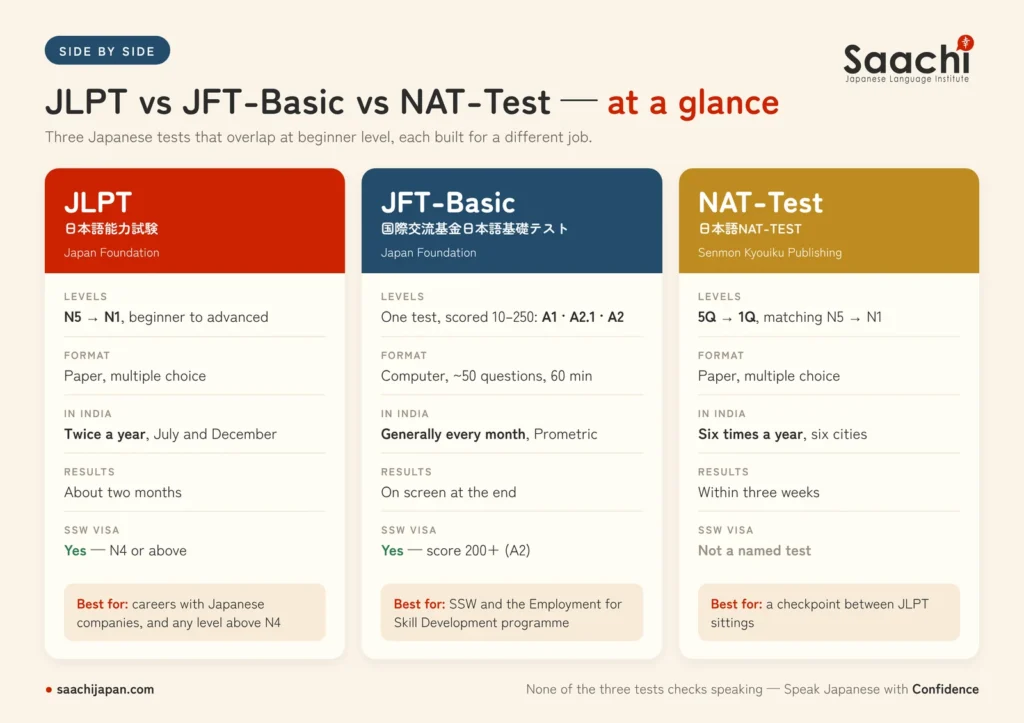
| JLPT | JFT-Basic | NAT-Test | |
|---|---|---|---|
| Run by | Japan Foundation | Japan Foundation | Private test body, Japan |
| Levels | N5 → N1 | One test, scored 10–250 (A1 / A2.1 / A2) | 5Q → 1Q |
| Highest level it can prove | Advanced (N1) | A2: basic everyday Japanese | Advanced (1Q) |
| Format | Paper, multiple choice | Computer, about 50 questions, 60 min | Paper, multiple choice |
| How often in India | Twice a year (July, December) | Generally every month | Six times a year, in six Indian cities (not all at every sitting) |
| Results | About two months | On screen at the end of the test | Within three weeks |
| Accepted for SSW visa | Yes, N4 or above | Yes, 200+ (A2) | Not one of the named tests |
| Best known to employers | Yes | Within visa programmes | Limited |
| Speaking tested? | No | No | No |
Check dates and current fees with the official test body before you register; schedules change each year.
Which test for which goal
“I want to work in Japan through the SSW visa.”
For Specified Skilled Worker (i), you need two things: a sector skills test, and proof of Japanese at A2. That proof is either a JFT-Basic score of 200 or more or JLPT N4. Nursing-care applicants also take a separate care-Japanese evaluation test.
Most SSW candidates take the JFT-Basic, and the reason is practical. It runs almost every month and gives your score on the day. The JLPT gives you two chances a year and a two-month wait. If your agency or employer has a start date, timing matters.
Two rules to know. Once you score 200 or more on the JFT-Basic, you cannot sit it again. And after any attempt, you cannot retake it for 45 days, counted from the day after your test. Do not book it “just to see”. Go in prepared.
Our route-by-route guide to working in Japan sets out what each visa route needs beyond the language test.
“I am looking at the Employment for Skill Development programme.”
Japan’s Technical Intern Training Program (TITP) is being replaced by the Employment for Skill Development programme (育成就労, ikusei shūrō), scheduled to start in April 2027. The new programme checks Japanese at three points:
- Before you start work: generally A1.
- If you change employers by your own choice: the Japan Foundation says its A2.1 band is expected mainly to confirm this requirement.
- When you move up to SSW (i): A2.
Those three stages are why the JFT-Basic now reports A1, A2.1 and A2. A JFT-Basic score of 145+ shows A1, and JLPT N5 is the other common proof at entry. Requirements can differ by sector and by the circumstances of a transfer, and some details are still under review. Check the latest official guidance, and confirm with the organisation handling your placement, before you apply.
“I want a career with Japanese companies.”
Here the JLPT is generally the strongest choice of the three. It has five levels, N5 to N1, and it is the most widely recognised. The JFT-Basic stops at A2, which is enough for daily life but rarely what an office or engineering role asks for. The NAT-Test has higher levels, but employers ask for it by name far less often.
For office and technical roles, N3 can be a useful milestone, and N2 is a valuable target for work involving a lot of Japanese communication, reading and documents. Requirements vary by employer and position, so check what the roles you are interested in actually ask for. A certificate shows tested proficiency. It does not replace practical speaking skills or an interview.
“I want to study at a Japanese language school in Japan.”
Language schools in Japan generally require evidence of beginner-level Japanese. JLPT N5 or higher is the most widely recognised route. Since August 2026 an A1-or-higher result on the JFT-Basic can also serve as that evidence, subject to the applicable requirements. Some schools also accept the NAT-Test 5Q, which helps if your JLPT result will not arrive before the school’s application deadline. Check the latest immigration guidance and your school’s own admission criteria before you register for any test.
“I missed the December JLPT. What now?”
Registration for the 6 December 2026 JLPT closed in September, so the next chance at a JLPT certificate in India is the July 2027 sitting. That is a long gap if you are studying steadily. A NAT-Test sitting in between gives you real exam conditions, a timed paper and a result in a few weeks. Use it as a checkpoint to see where your listening and reading actually stand. Then sit the JLPT in July for the certificate that carries weight.
Five traps that catch Indian learners
- Taking the JFT-Basic for a career that needs the JLPT. A high JFT-Basic score, say 220, is not “equivalent to N3”. It proves A2. The two tests are different and their levels are not direct equivalents, but A2 is the level the SSW visa accepts alongside JLPT N4. If your goal is an office job, it is unlikely to be what employers ask for.
- Assuming someone else’s advice fits your route. The JFT-Basic is often recommended because it suits SSW timelines. That makes sense for SSW, but it may not fit study or career goals. Check the requirements for your own route.
- Treating the NAT-Test as a JLPT substitute on a CV. NAT-Test levels are designed to match the JLPT in difficulty, but the recognition is not the same. List it, but do not count on it.
- Booking the JFT-Basic underprepared. The computer format and on-screen result make it feel low-stakes. With a 45-day gap between attempts, an unprepared sitting costs you six weeks.
- Thinking a certificate means you can speak. None of these three tests has a speaking section. Interviewers, colleagues and supervisors in Japan will judge you on conversation first. A certificate without speaking practice is half the preparation.
Does preparation differ between the tests?
Less than you might think. At the beginner end, all three test the same foundation: kana, core kanji, everyday vocabulary, basic grammar, and listening to Japanese at natural speed. Someone ready for JLPT N4 is generally in a strong position for a JFT-Basic score of 200 and for NAT-Test 4Q.
The differences are in the delivery:
- JFT-Basic leans on everyday, practical scenarios such as shop signs, announcements, workplace instructions and short conversations. It is also on a computer, so practise reading Japanese on screen and pacing yourself against a clock you cannot pause.
- JLPT is more grammar-dense and puts more weight on reading longer passages, especially from N3 upwards.
- NAT-Test follows the JLPT format closely, so JLPT preparation carries over almost directly.
For reference, the levels most relevant here take time to build. At Saachi, N5 is about 100 hours of class and around 130 kanji, and N4 is a further 100 hours and around 340 kanji. Plan for the level first. The choice of test is the easier part.
How Saachi helps
Our courses are built around the JLPT levels, so whichever certificate you aim for, you are working from the same solid foundation. Classes are live online, 2 to 2.5 hours, twice a week, with students joining from across India. Batches run with 18 to 35 students. That is a deliberate advantage: you get plenty of classmates at your level for pair work, role plays and presentations.
- Conversation in every class. None of these tests checks speaking, so we make sure you can actually use the Japanese you are being certified in.
- Assessments every five lessons that combine written and conversation tests, so you know where you stand before you book any exam.
- Native Japanese sensei sessions alongside qualified N1 and N2 trainers.
- Exam preparation built in, with revision and mock tests in JLPT format. That format also covers most of what the NAT-Test and the JFT-Basic ask.
Beginner (N5) batches start almost every month, and N4, N3 and N2 batches start after each JLPT exam. If you are aiming at SSW, our JLPT N4 course takes you to the level that both the JLPT and the JFT-Basic accept.
Your next step
Settle two things before you choose a course: which test your goal needs, and where your Japanese stands today. Use the goal guide above for the first. For the second, take our free JLPT level test, then read how to choose the right JLPT level to see where you should aim.
Still unsure which test fits your plans? Send us an enquiry or message us on WhatsApp at +91 95914 57722. Tell us your goal and your level, and we will help you pick the right test and the course that gets you there.
Speak Japanese with Confidence.


