Ask any Japanese teacher in India why their students started, and anime will be near the top of the list, which is why can you learn Japanese from anime is one of the questions we’re asked most. It’s a good reason to start. The problem comes later, when a learner who has watched four hundred episodes sits down in a real conversation and discovers that almost nothing they absorbed is usable, not because it was wrong, but because it belongs to a register no adult would use at work.
So: can you learn Japanese from anime? Partly, and more than the purists admit. But not the way most people try to. This post separates what anime genuinely teaches from what it quietly fails to, and gives you a method for turning watching into actual ability.
Not sure where you currently stand? Take our free level test — about twenty minutes, and it tells you which level you should actually be studying.
The short answer
- Anime is excellent input and terrible instruction.
- It builds your ear faster than any textbook. It builds your grammar, reading and politeness almost not at all.
- Used alongside structured study, it can cut months off your listening timeline. Used instead of structured study, it produces learners who sound fluent for one sentence and then stall.
What anime genuinely gives you
Credit where it’s due — these are real advantages, and learners who dismiss anime entirely are leaving them on the table.
- An ear for the rhythm of the language. Japanese has pitch patterns, mora timing and sentence-final music that no amount of reading will teach you. Hundreds of hours of listening tunes this in the background, and it’s the single hardest thing to fix later.
- Vocabulary through repetition in context. You don’t memorise 仕方がない from a list. You hear it forty times in situations where it obviously means “nothing to be done”, and it’s yours.
- Consistency. The most underrated factor in language learning is showing up daily, and people show up for something they enjoy. A learner who watches twenty minutes every night for two years beats one who does three intense weeks and quits.
- Cultural pattern-recognition. Seniority, indirect refusal, the weight of silence, who bows to whom — you absorb the shape of these long before anyone explains them.
What anime cannot give you
- Reading. This is the big one for exam purposes. Kanji, vocabulary and reading make up two of the three JLPT sections, and anime contributes nothing to any of them. A learner with superb anime listening can still fail N4 outright.
- Production. Recognising a phrase and being able to build one yourself are different skills that live in different parts of your ability. Watching is entirely passive; no amount of it makes you a speaker.
- Politeness. Covered below, because it deserves its own section — it’s where the real damage happens.
- Correction. Anime never tells you that you misheard, misunderstood, or picked up the wrong nuance. Mistakes made alone tend to set.
The register problem: what you hear vs what you’d actually say
Most anime dialogue is casual plain form, often deliberately rough — it’s written for drama, not for the office. Real adult Japanese runs on です・ます form by default, with keigo layered on top for customers and seniors. Here’s the gap, line by line:
- おれ / おまえ (I / you, blunt) → わたし and the person’s name plus さん. Adults rarely say “you” at all.
- 行くぞ! → 行きましょう。
- 知らねぇ → わかりません。
- うまい! / すげぇ → おいしいです。 / すごいですね。
- なんだよ → どうしましたか。
- 〜てくれ (do it) → 〜ていただけますか。
- だまれ → there is no workplace equivalent, and that’s the point.
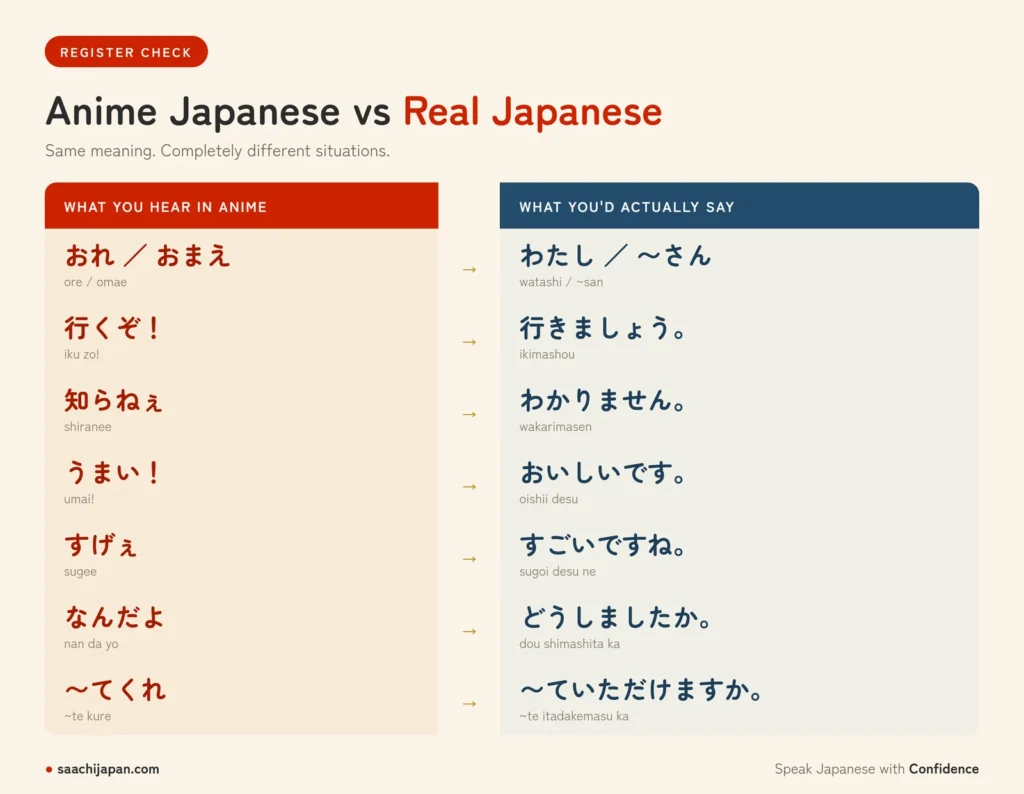
None of the left-hand column is incorrect Japanese. All of it is wrong in the situations most Indian learners will actually be in — a client call, a Japanese manager, a language exam, a visa interview. Saying おまえ to a Japanese colleague isn’t a small slip; it lands somewhere between rude and bizarre.
And then there’s role language
Japanese fiction uses 役割語 (yakuwarigo, “role language”) — speech patterns that instantly signal a character type and that nobody uses in life. The elderly sage says わし and 〜じゃ. The samurai says ござる. The arrogant rival says 〜だぜ and possibly 俺様. These are costumes, not dialects.
Three examples you will already know:
- Goku’s おら in Dragon Ball (Toei Animation). A textbook case of country-person role language — conventionally read as north-eastern, but it isn’t a faithful transcription of any real dialect. Say おら in a Bengaluru office call with Tokyo and you will get a very long pause.
- Naruto’s だってばよ (Studio Pierrot). Built on a real emphatic particle — 〜ってば, “I’m telling you” — but assembled into a form no one actually says. It’s a character tag, which is why his mother and son get their own variants.
- The archaic speech in Inuyasha (Sunrise) and parts of Demon Slayer (ufotable). Sengoku and Taishō settings bring deliberately old-fashioned diction. Lovely writing, and about as useful for your next client meeting as Shakespeare is for a job interview.
Learners who absorb this register sound, to a Japanese ear, roughly like someone speaking English entirely in lines from a pirate film.
Three traps that catch Indian learners specifically
- Skipping the beginner grind because the language already sounds familiar. Anime makes Japanese feel approachable, which is a gift — but familiarity isn’t foundation. Learners who start at N4 material because “N5 is stuff I already know” almost always have holes in particles, て-form and counters that surface painfully later.
- A lopsided skill profile that the JLPT punishes. We see this often: strong listening, weak everything else. The JLPT has sectional pass marks, so being brilliant at one part cannot rescue you from the others. If your kanji is where your listening is, you’re in good shape — if it isn’t, that’s the priority.
- Carrying casual form into a professional India–Japan context. Most of our learners end up using Japanese with colleagues, clients or managers rather than with friends. That’s the exact setting where anime register does the most damage — and where the unwritten rules matter more than vocabulary. Our post on 8 unwritten rules of Japanese business covers what that world actually expects.
How to use anime well, level by level
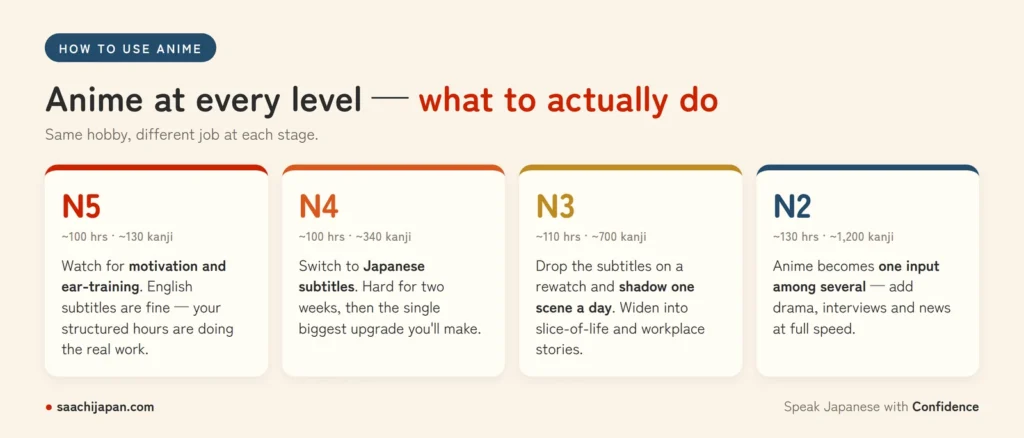
At N5 (~100 hours, ~130 kanji)
Keep watching, but for motivation and ear-training only, and with no expectation of learning grammar from it. Your structured hours are doing the real work at this stage. Watch with English subtitles if you like — you’re not ready to do without them, and pretending otherwise just makes the hobby feel like homework.
At N4 (~100 hours, ~340 kanji)
Switch to Japanese subtitles. This is the single highest-value change you will make, because it links the sound you already know to the written form you don’t. It will feel impossible for two weeks. Then it won’t.
At N3 (~110 hours, ~700 kanji) and beyond
Start doing without subtitles on a rewatch, and widen your diet — workplace and slice-of-life series, drama, interviews, news. By N2 (~130 hours, ~1,200 kanji) anime should be one input among several rather than your main one. See our step-by-step N4 study plan for what the structured half of this should look like.
What to watch if you want usable Japanese
The rule of thumb: ordinary lives teach ordinary Japanese. The further a show sits from daily life, the more of its dialogue you have to throw away.
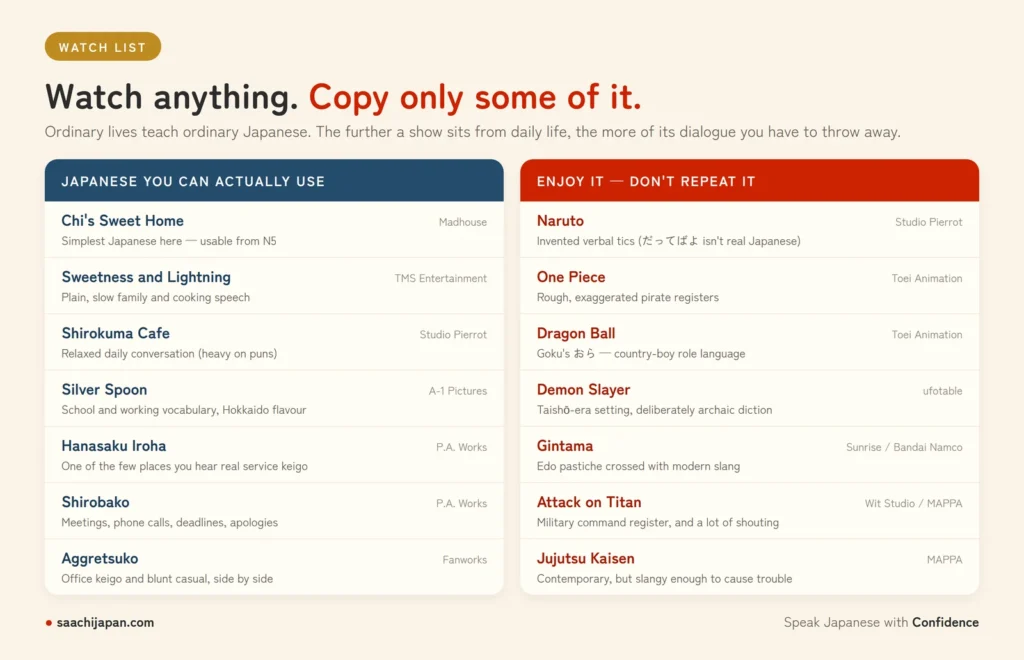
Everyday modern Japanese — the useful list
- Chi’s Sweet Home (Madhouse, 2008) — three-minute episodes and the simplest Japanese on this list. Usable from N5.
- Sweetness and Lightning (TMS Entertainment, 2016) — cooking and family life, plain and slow, genuinely kind.
- Usagi Drop (Production I.G, 2011) — domestic adult-and-child speech with no jargon at all.
- Shirokuma Cafe (Studio Pierrot, 2012) — relaxed everyday conversation, though be warned it runs on puns.
- Silver Spoon (A-1 Pictures, 2013) — school and farm life in Hokkaido, and a lot of practical vocabulary.
- March Comes in Like a Lion (Shaft, 2016) — adult, quiet, natural. Good from N3.
- Hanasaku Iroha (P.A. Works, 2011) — set in a traditional inn, and one of the few places you’ll hear real service keigo in use.
- Shirobako (P.A. Works, 2014) — meetings, phone calls, deadlines and apologies. The closest thing on this list to business Japanese practice.
- Aggretsuko (Fanworks, 2018) — office keigo and blunt casual speech side by side in the same scene. It is the register lesson in this post, in show form.
Great stories, unusable Japanese
- Naruto (Studio Pierrot), One Piece (Toei Animation) and Dragon Ball (Toei Animation) — invented verbal tics and thick role language throughout.
- Demon Slayer (ufotable) — Taishō-era setting, with several characters written in deliberately archaic speech.
- Gintama (Sunrise, later Bandai Namco Pictures) — Edo pastiche crossed with modern slang, on purpose.
- Attack on Titan (Wit Studio for seasons 1–3, MAPPA for the final season) — military command register and a great deal of shouting.
- Jujutsu Kaisen (MAPPA) — contemporary Japanese, but rough and slangy enough to get you in trouble.
Watch all of it. Just don’t repeat any of it at work.
Somewhere in between
- Studio Ghibli films — natural adult dialogue, slow enough to follow, and the gentlest bridge from subtitles to no subtitles.
- Spy × Family (Wit Studio and CloverWorks) — modern and warm, though Anya’s broken toddler speech is exactly what you don’t want to copy.
- K-On! (Kyoto Animation) — casual schoolgirl speech: excellent for your ear, useless for your first 面接.
- Your Name (CoMix Wave Films) — beautiful and natural, but it’s built on dialect and on pronoun choice, so treat it as listening practice rather than a model.
The method that converts watching into ability
Passive watching plateaus quickly. This four-step routine, done on a single two-minute scene, is worth more than a whole episode consumed passively:
- Watch it once normally, subtitles on, just to follow the scene.
- Watch it again with Japanese subtitles and pause at every line you couldn’t catch. Look up no more than five words — past five, you’re studying a dictionary, not a scene.
- Shadow thirty seconds of it — play a line, say it out loud immediately after, matching the rhythm and intonation. This is the step that moves the language from your ears to your mouth, and it’s the one everyone skips.
- Convert one line into polite form in writing. すげぇ、うまくいったぜ → とてもうまくいきました。This single habit inoculates you against every problem described above.
Fifteen minutes a day of that will outperform two hours of passive watching, and it turns a hobby you already have into study time you don’t have to find.
Where a course fits in
Anime gives you input and motivation. What it can’t give you is the thing it never does: correct you, make you speak, or teach you to read. That’s the gap a structured course closes.
At Saachi, classes are conversation-based rather than exam-paper-based — pair work, role plays and student presentations in every batch, plus native sensei sessions, so the Japanese you recognise becomes Japanese you can produce. Written work gets corrected individually, and there’s assessment every five lessons so gaps surface early instead of at the exam. Batches run 18 to 35 students, which means plenty of people to practise with, in sessions of 2 to 2.5 hours twice a week; a level takes four to six months, and new batches start almost every month, including weekday evening batches for working professionals.
If anime is where you started, our JLPT N5 course is where the foundation gets built properly — around 100 hours and ~130 kanji, taught by experienced senseis (JLPT N1/N2, BJT Level 2, Native speakers). Classes run online across India, Japan and other countries.
Take the free level test to find your starting point, or send us an enquiry and talk it through with our counsellers.
Keep going
Don’t stop watching. The learners who get furthest are almost never the ones with the most discipline — they’re the ones who found a version of Japanese they actually wanted to spend time with. Anime is a fine reason to begin, a useful tool throughout, and a poor teacher on its own. Pair it with structure and it stops being a guilty pleasure and starts being an unfair advantage.
At Saachi, the goal is simple: help you Speak Japanese with Confidence — one level at a time.