
N3 is the level where Japanese stops being a subject you study and starts being a language you use. It’s also the level where many learners get stuck — and usually for the same reason: JLPT N3 preparation needs a different method from the one that got you here. N5 and N4 can be approached largely through memorisation. This method alone does not work for N3. The exam stops asking, “Do you recognise this pattern?” and starts asking, “Did you actually understand that paragraph?”
This guide covers what that really involves: what the exam tests, how long it takes, and the part most study plans skip: how to change your method now that flashcards alone won’t carry you. It’s written for Indian learners, so we’ll flag the traps that catch us specifically.
Not sure N3 is your next step? Take our free level test first — it takes about twenty minutes and tells you exactly where you stand.
Why N3 feels like such a jump
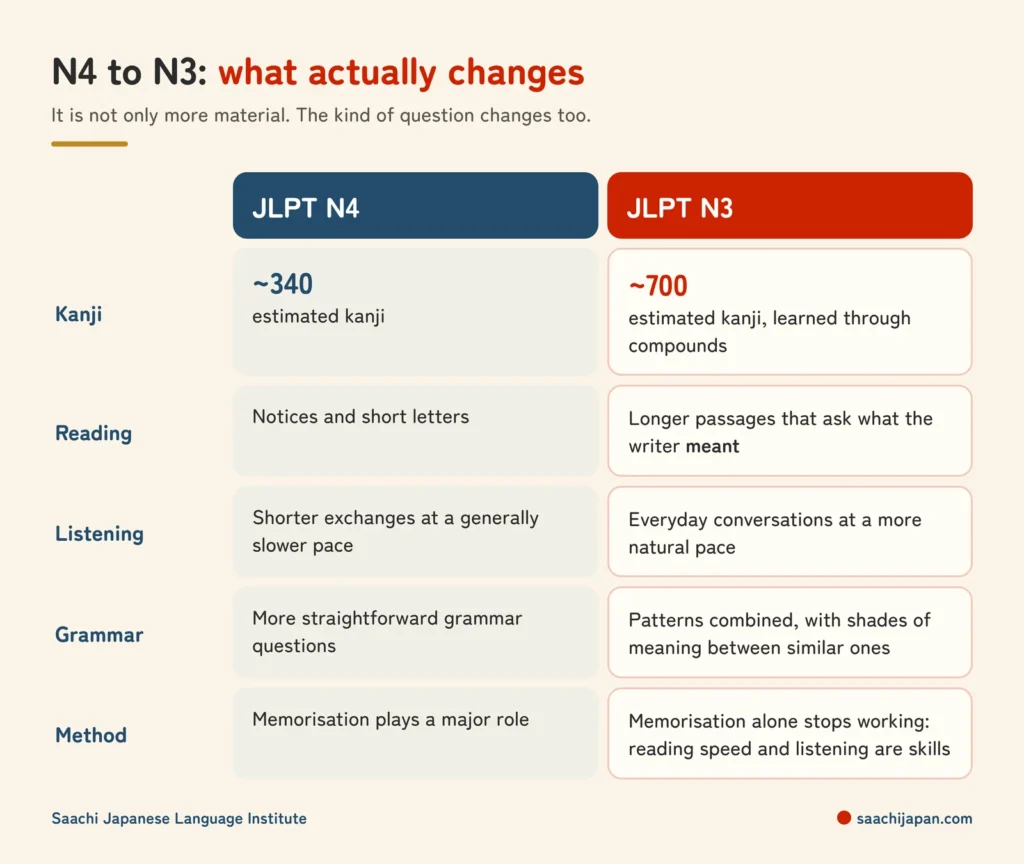
The gap between N4 and N3 is often considered the widest in the JLPT ladder, and it isn’t only about volume. Three things change at once:
- The material increases significantly. Kanji is often estimated at around 700 characters at N3, compared with roughly 340 at N4; vocabulary is often estimated at around 3,750 words.
- The reading gets longer. N4 includes notices and short letters. N3 introduces longer passages and asks what the writer meant, not just what they said.
- The listening becomes more natural. You are expected to follow everyday conversations at a more natural pace, often without the support of visual cues. This can be a major challenge for N3 candidates.
There’s a fourth, quieter change: N3 sits between the “beginner” levels (N5, N4) and the “advanced” ones (N2, N1), and the official materials for it are thinner. You have to be a bit more deliberate about where your practice comes from.
What JLPT N3 actually tests
- Kanji: around 700 (up from ~340 at N4)
- Vocabulary: around 3,750 words
- Grammar: a broad range of grammar patterns — causative, passive, causative-passive, honorific and humble forms, and a long tail of nuance patterns (〜わけ, 〜ばかり, 〜ようとする, 〜おかげで/せいで)
- Reading: longer passages, essays, emails and simple articles — including questions about the author’s intent
- Listening: everyday and workplace conversations at natural speed, including questions where you hear the options only once
In one line: N3 is the Japanese you’d need to hold your own in an ordinary day in Japan — a conversation with a colleague, a notice on a wall, an email you weren’t expecting.
How long does N3 take?
As a guide, a 110-hour structured course can provide a useful framework, but total preparation time varies considerably. In calendar terms:
- ~5–6 months at 5 hours a week, or
- ~3–4 months at 8 hours a week
Two honest caveats. First, that 110 hours assumes your N4 is genuinely solid — if it isn’t, you’ll spend the first month strengthening foundations rather than building. Second, N3 punishes stop-start study more than the lower levels do, because so much of it is skill-building (reading speed, listening comprehension) rather than fact-learning. Skills fade when you pause; facts don’t fade as fast.
Your JLPT N3 preparation plan, phase by phase
Rather than a week-by-week timetable, think of N3 in three phases.
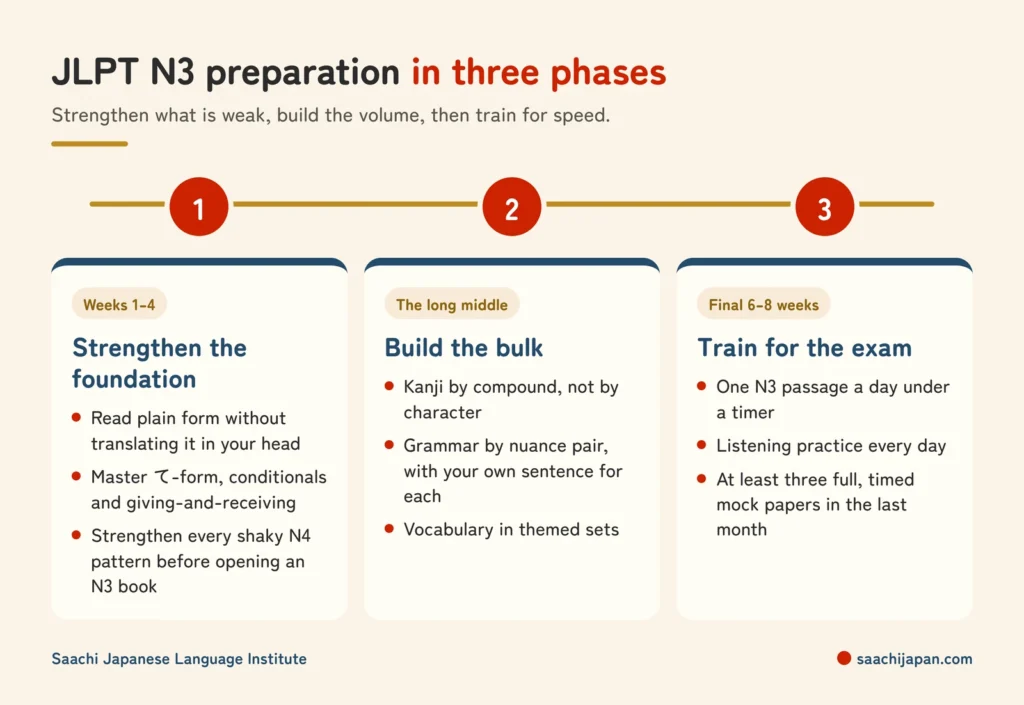
Phase 1 — Strengthen the foundation (weeks 1–4)
Before you buy a single N3 book, be honest about N4. Can you read plain form at speed without converting it to polite form in your head? Are て-form, conditionals and giving-and-receiving automatic, or do you still pause? Every weak N4 pattern can become a problem at N3, because N3 questions combine patterns and test how well you understand them in context.
If you’re unsure, our step-by-step JLPT N4 study plan lists the areas that should be solid by now. Spend three or four weeks strengthening those areas. It may feel like going backwards. It isn’t.
Phase 2 — Build the bulk (the long middle)
This is where the roughly 700 kanji, 3,750 words and the wide range of N3 grammar patterns get learned. Three rules make this phase survivable:
- Kanji by compound, not by character. At ~700 kanji, learning characters in isolation stops working — the readings collide. Learn 経 through 経験 and 経済, and the readings anchor themselves to real words. A steady weekly target of roughly 20–25 new kanji can help maintain momentum. If the basic set still feels shaky, shore it up first with our guide to everyday Japanese kanji.
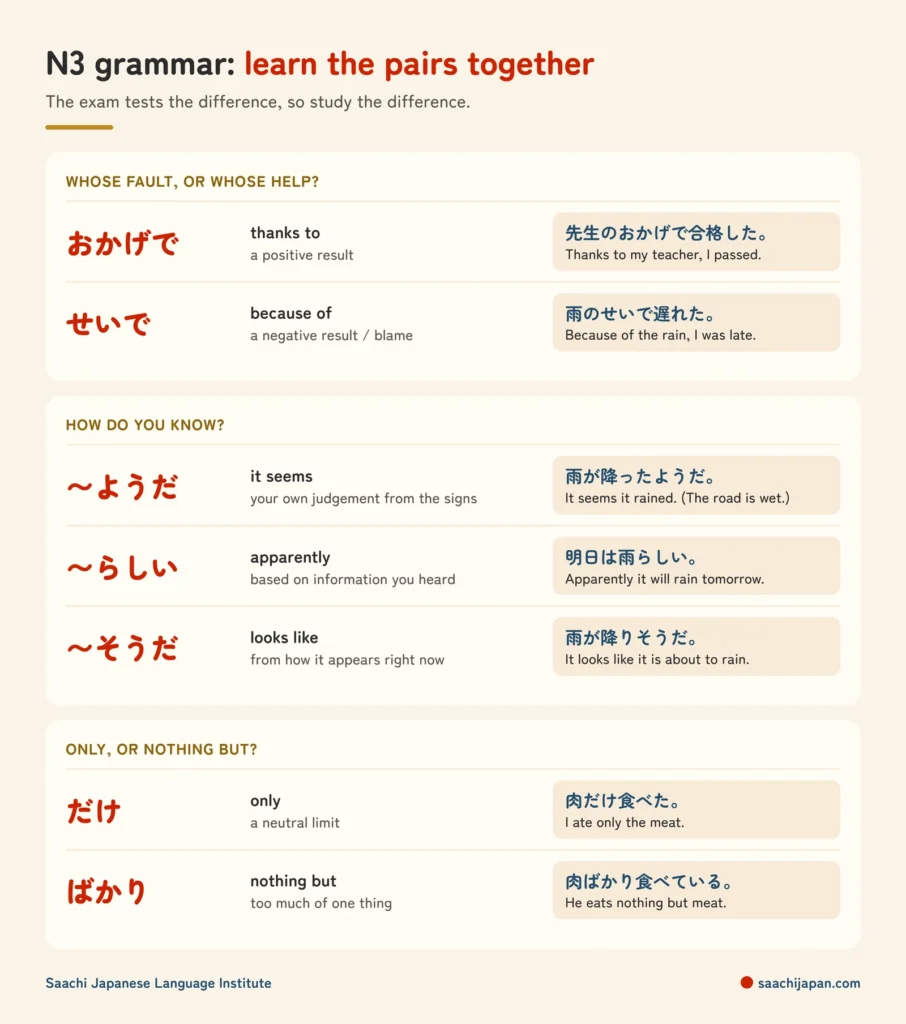
- Grammar by nuance pair. Much of N3 grammar is about shades of meaning, and the exam tests exactly those shades. Study the confusable pairs together — おかげで vs せいで, 〜ようだ vs 〜らしい vs 〜そうだ, ばかり vs だけ — and write your own sentence for each. If you can’t produce it, you don’t know it yet.
- Vocabulary in themes. Work, health, travel, opinions, feelings. A themed set of 30 words sticks; 30 unrelated words don’t survive the weekend.
Phase 3 — Train for the exam (final 6–8 weeks)
N3 is as much a test of speed as of knowledge, and this phase is where you build it. Read one N3-level passage a day under a timer. Do listening practice every single day. Then, in the last month, sit at least three full, timed mock papers in one go — same start time as the real exam, no pausing, no dictionary.
Many candidates who have adequate Japanese knowledge still struggle because of pacing. The reading section runs out of time long before it runs out of questions.
The three skills that decide your N3 result
Reading: stop translating
At N5 and N4 you could translate each sentence into English (or Hindi, or Kannada, or Marathi) and still finish in time. At N3 that habit costs too much: it slows your reading sharply, and the clock won’t allow it. Practise reading a paragraph for its gist before you understand every word, and resist looking up unknown words on the first pass. Uncomfortable at first, essential by exam day.
Listening: natural speed, from today
This is a common challenge for Indian learners, because most of us learn Japanese primarily through the eyes — textbooks, apps, written notes. N3 audio runs at a more natural conversational speed, with little visual support. Fifteen minutes a day of real spoken Japanese — N3 listening practice sets, Japanese news, or drama with Japanese subtitles you gradually stop reading — does more than three hours the weekend before. Anime counts too, with caveats; we cover them in Can You Learn Japanese from Anime?
Grammar in use, not grammar in lists
Recognising 〜わけではない on a page is not the same as producing it. Speaking practice — with a trainer, a partner, anyone who will correct you — is what converts recognised grammar into usable grammar. It can also strengthen the listening skills the exam requires.
Common N3 mistakes that catch Indian learners
- Jumping to N3 with a shaky N4 base, then blaming N3 for being hard
- Translating in your head — a major cause of running out of time in the reading section
- Treating N3 grammar as a long list of separate facts instead of clusters of nuance
- Studying kanji as isolated characters once the count passes ~500
- Leaving listening for the final month, when it’s the slowest skill to build
- Skipping full-length timed mocks, so exam day is the first time you sit the whole paper
Recommended textbooks for N3
A stack that works well: Sō Matome N3 (five slim books — grammar, kanji, vocabulary, reading, listening — friendly and well-paced), Shin Kanzen Master N3 for grammar and reading when you want a tougher drill, Try! N3 if you prefer grammar taught inside conversations, and Speed Master N3 for vocabulary. You don’t need all of them. Sō Matome as your spine plus Shin Kanzen Master grammar is plenty — and add the official JLPT practice workbook plus a book of N3 mock tests for Phase 3.
Is N3 enough for working in Japan?
N3 is often described as the minimum level for workplace Japanese, and it can be workable for many roles — particularly in IT and engineering, where a lot of technical communication may happen in English. For customer-facing work, most healthcare roles and anything document-heavy, N2 is the realistic target.
So treat N3 as the level that opens the conversation rather than a guarantee of anything. If working in Japan is your goal, our guide to which Japanese level you need to work in Japan maps the levels to actual roles and routes.
How Saachi helps you get there
Our JLPT N3 course runs about 110 hours and covers the kanji and vocabulary needed for N3 preparation. Classes are live online, 2 to 2.5 hours twice a week, and they are conversation-based: pair work, role plays and student presentations in every batch, sessions with native Japanese sensei, and an assessment every five lessons so gaps show up early rather than on exam day. Saachi is led by founder and chief trainer Lata Naik (JLPT N1, BJT Level 2, 18+ years of teaching), with qualified N1 and N2 trainers. New JLPT N4, N3 and N2 batches start after each JLPT exam; beginner (JLPT N5) batches start almost every month.
Not sure whether to start N3 or consolidate N4 first? Take the free level test and it’ll point you to the right starting place — or send us an enquiry or message us on WhatsApp at +91 95914 57722 and talk it through with a trainer.
Keep going
N3 is the bridge. For many learners it’s the longest crossing in the JLPT ladder, and it’s the one that changes what Japanese is for you — from a set of patterns you’ve learned into a language you can actually live in. Clear it, and N2 is a matter of depth rather than a change of kind.
This post completes our prep series: N5 → N4 → N3.
At Saachi, the goal is simple: help you Speak Japanese with Confidence — one level at a time.


